
Explain what changed in gross margin—and where it changed
Find the products, regions, channels, or other business locations behind a margin movement. FactorPrism ranks the drivers, keeps gains and declines visible, and reconciles the bridge to the reported change.
Ready for your own data? Install from Snowflake Marketplace
“Margin compressed. Where did the movement originate?”
Margin movement hides in the interaction of many segments — some profitable, some loss-making, some flipping between quarters. The question isn't just which segments moved; it's where the compression lives: a broad-based cost force, or three specific product lines underwater.
The problemZero breaks the usual math
Percent-change math fails at zero
A segment going from −10K to +10K has no meaningful growth rate; tools either drop these segments or produce nonsense.
Flat rankings lose the business hierarchy
A list of products or regions does not show whether the movement was broad-based or concentrated deeper in one part of the business.
Averaging across mixed signs misleads
Profitable and unprofitable segments offset inside any aggregate, so "margin roughly flat" can hide two large opposing stories.
A short explanation that ties to the reported margin
The useful output is not every segment that moved. It is the business locations that best explain the movement, their direction and contribution, and whether gains and declines offset.
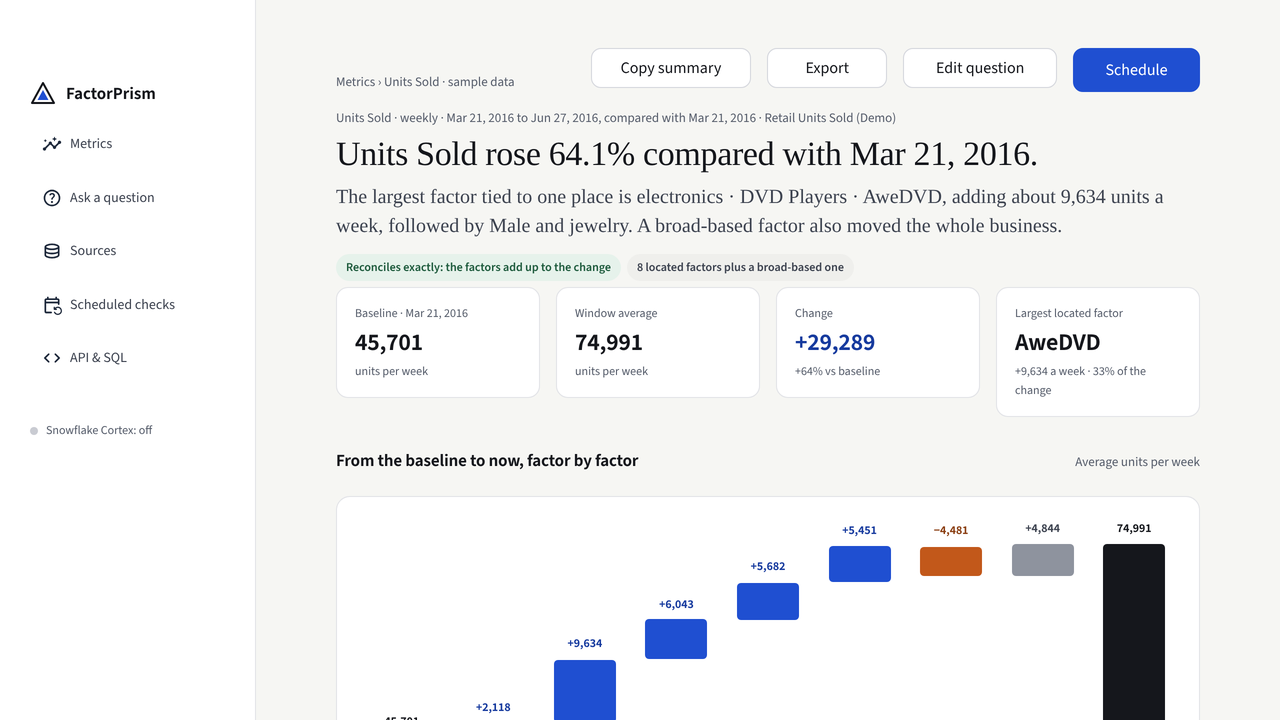
Built for numbers that cross zero
FactorPrism®'s engine handles negative values and sign-crossing series natively:
Gains separated from declines
Offsetting stories stay visible instead of netting out to "flat."
Magnitude and direction, at the location where each factor acts
A cost force compressing every product line vs one line that flipped to loss — reported as different things, because they are.
Reconciles exactly to your reported margin change
Finance-grade and auditable — the bridge ties out to the unit.
Works for any sign-crossing metric
Net cash flow, net adds, P&L lines, contribution margin — same engine, same guarantees.
Related: Budget vs actual · Revenue bridge · Churn & net-adds movement · vs Snowflake's built-in functions
Common questions
What is a gross margin bridge?
A gross margin bridge connects a baseline margin to a later result by quantifying the positive and negative business drivers behind the change.
Can FactorPrism analyze negative or sign-crossing margins?
Yes. FactorPrism supports business metrics whose values can be negative or cross zero, including margin and net-flow measures.
Does margin data leave Snowflake?
No. FactorPrism runs inside the customer's Snowflake account and uses read-only access to only the table or view the customer selects.
Bring the number your team is still debating.
We will walk through one real question with you, on a sample or a source you choose.