Simple effects hide at the wrong level
A regional cut can look harmless while one state, division, or product line drives the change. Unless you choose that level, the effect stays buried in the aggregate.
Region blames product. Product blames channel. Every view looks plausible because the same sales appear in several cuts. FactorPrism separates the overlap to find what’s driving the change automatically.
Even a simple factor may sit at one specific level: state instead of region, SKU instead of product. You find it only if you drill to the right place. Add independent dimensions and their intersections, and the number of plausible cuts grows too quickly to search one by one.
A regional cut can look harmless while one state, division, or product line drives the change. Unless you choose that level, the effect stays buried in the aggregate.
A broad lift can conceal a local decline. A beat and a miss can cancel. “Flat overall” can contain two urgent, opposing stories.
Region may look normal. Product may look normal. The specific region × product intersection can still contain the decisive movement—and no separate one-dimensional cut can isolate that answer.
Was the movement a company-wide lift, strength across the South, growth in Jewelry everywhere, or something specific to South × Jewelry?
A manual search has no reliable stopping point: every explanation can fit part of the visible pattern, and you cannot know whether an unchecked level or intersection contains the real factor.
FactorPrism examines the relevant levels and intersections in one analysis. It searches beyond the hypotheses an analyst happened to think of, finds a compact set of factors that explains the observed movement, locates each one where it acts, and measures its contribution.
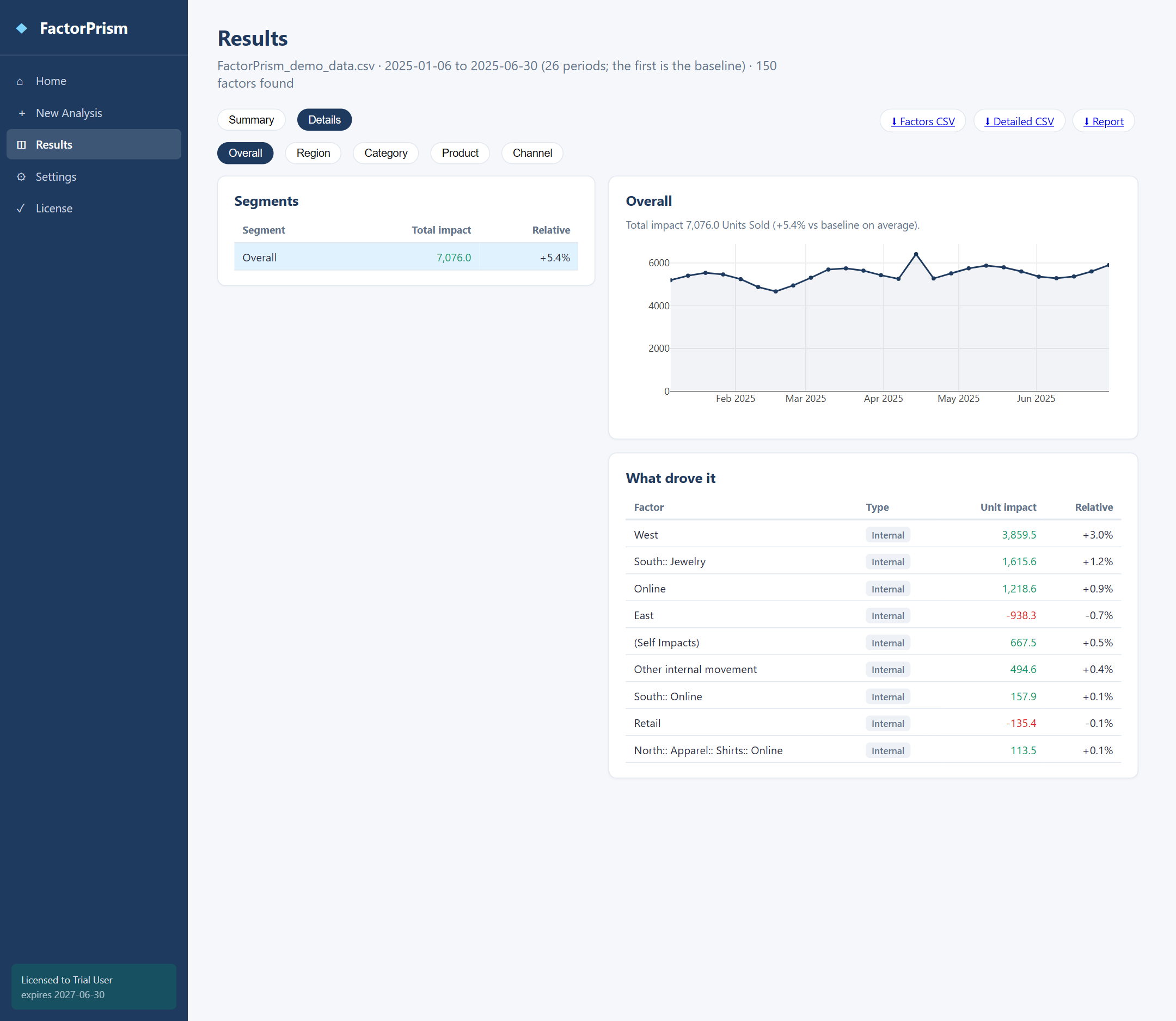
FactorPrism draws on methods from signal processing, adapted for business metrics, to separate overlapping movements across dimensions and their intersections.
The analytics engine determines where the movement occurred and how much each factor contributed before AI helps communicate the result. The narrative follows the measurements; it does not invent them.
Each Finding links the headline to ranked factors, timelines, business locations, comparisons, prior runs, and a focused Investigation Plan.
The practical difference: you do not need to guess every useful cut in advance, and you do not need to hand-build an explanation from a pile of overlapping percentages.
Grant read-only access to one Snowflake table or view and select the metric, time grain, and business dimensions.
Choose the comparison window or plan column that represents the business question the team needs to answer.
Review the measured factors and evidence, then carry the strongest signals into focused next investigations.
Bring one real business surprise to a guided evaluation. We will test which factors FactorPrism can surface automatically across the dimensions.