
TOP_INSIGHTS finds interesting segments. FactorPrism explains the whole move.
Snowflake's built-in functions and agents are excellent building blocks. A reconciled answer to why a metric moved is a different job: every factor located in your hierarchy, and all of them adding up to the change.
Ready for your own data? Install from Snowflake Marketplace
Building blocks versus a finished answer.
| Snowflake built-ins (TOP_INSIGHTS, Contribution Explorer, Snowflake Intelligence) | FactorPrism | |
|---|---|---|
| What you get | Segments flagged for an analyst, or a chat answer | A Finding: the answer, ranked factors, their evidence, what to check next |
| Adds up to the change | No. Results overlap and you reconcile by hand | Yes. The factors add up to the change exactly |
| Respects your hierarchy | Flat segments | Each factor at the level where it acts, broad-based or local, including combinations |
| Metrics that cross zero | Awkward (the function expects non-negative metrics) | Supported: margin, net flows, P&L lines |
| Over time | Two snapshots | Every period: when each factor started, built, or faded |
| Who uses it | SQL-writing analysts | Business users in the app; SQL, tasks and agents through the API |
| Data location | In Snowflake | In Snowflake, read-only on one object |
TOP_INSIGHTS screens segments. That is a different job.
SNOWFLAKE.ML.TOP_INSIGHTS fits a decision tree: give it dimensions, a metric and a control/test label, and it returns the segments most associated with the difference. That is useful screening in a worksheet. It does not place causes in your hierarchy, separate a broad-based force from a local one, or produce a bridge that sums to the change, so the analyst still assembles the story.
Snowflake Intelligence retrieves. "Why" is a computation.
Conversational retrieval over a semantic model answers "what was revenue by region last quarter?" well, and will tell you which region fell most. A complete "why" means checking every level and combination of region, product and channel, separating broad from local, and making the pieces reconcile. That is a multi-step computation, and agents can now call FactorPrism to do it: see FactorPrism for Cortex Code.
The finished analysisWhat FactorPrism adds.
It reconciles exactly
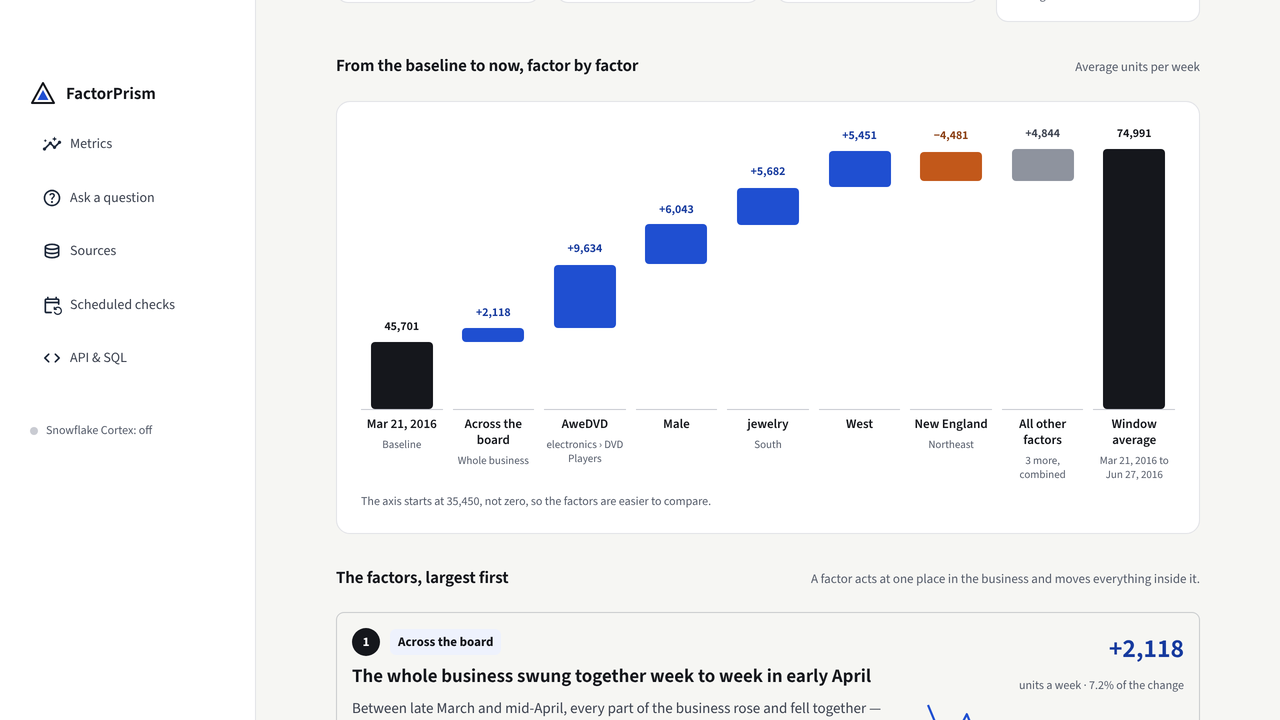
A bridge from baseline to now where the ranked factors add up to the change. The standard a finance audience already holds you to.
It finds where causes live
A broad force is reported once, at the top. A local problem is placed at its region, product, or combination.
It reads the whole window
Launches, step changes, slow builds and one-off spikes look different, with dates.
It is ready to hand over
One sentence first, then the evidence and what to check next. No SQL, semantic model or prompt to write.
Related: FactorPrism vs Cortex TOP_INSIGHTS · All comparisons · Accuracy benchmark
Honest answers
Can't we get this from TOP_INSIGHTS?
No — and not because it's a lesser tool, but because it's a different kind of tool. A decision tree flags segments associated with a difference; it doesn't locate causes in your hierarchy, separate broad-based forces from localized ones, or produce a bridge that sums to the change. If you've run it on a real variance question, you've seen the gap: a flat list of overlapping segments that doesn't tie out to the number you're explaining. Closing that gap is not a bigger decision tree — it's a different computation, and it's the one FactorPrism performs.
Is this competing with Snowflake?
No — FactorPrism exists because of Snowflake's platform. It's a capability you add to your account, reviewed through the Marketplace security process, billed through your Snowflake relationship.
What does FactorPrism need access to?
A read-only grant on the tables or views you choose to analyze — nothing more. Optionally CORTEX_USER (AI-written explanations) and CREATE DATABASE (keeping saved Findings in a database you own).
Can I see it without connecting data?
Yes. Open the sample Finding at factorprism.com/demo/finding/, or choose Open the sample Finding in the app. Neither needs a connection.
Run it next to the built-ins.
Bring a variance question you have already tried to explain, and compare the answers.